- Podcast
- Vacas lecheras
- Gestión
- Estrés
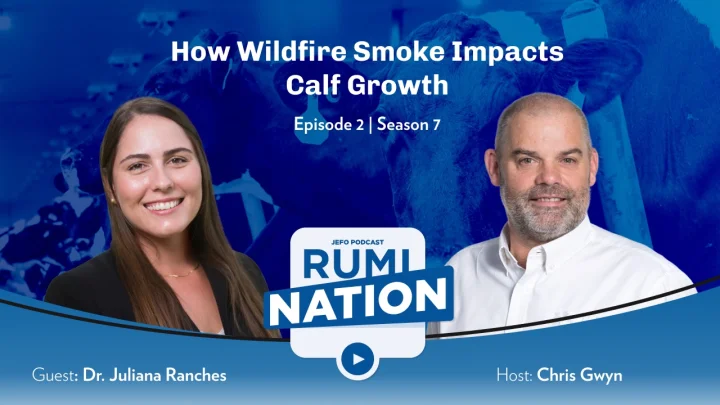
How Wildfire Smoke Impacts Calf Growth
This episode is available in English only.
In this episode, Dr. Juliana Ranches discusses how wildfire smoke impacts cattle health and performance, offering practical strategies producers can use today to protect herds and manage growing air quality challenges.
Our Guest Dr. Juliana Ranches
Dr. Juliana Ranches is an Assistant Professor at Oregon State University, based in eastern Oregon at the Eastern Oregon Agricultural Research Center (EOARC). She holds a master’s degree and a doctorate from the University of Florida. Her research and Extension programs focus on diverse topics important to cattle producers, with the primary goal of improving production efficiency and sustainability.

¿Tiene una sugerencia de tema?
¡Incluso puede convertirse en nuestro próximo invitado!
Timestamps & Summary
Chris Gwyn (02:19)
Tell us about your Rancher program and your background journey.
Dr. Juliana Ranches
Rancher is a webinar series that brings most of the day’s information to cattle producers and livestock producers around the globe. […]
I wanted it to be something unique that would highlight the work of women in this industry. So female scientists, ranchers, farmers, in the industry, faculty that work in the beef cattle industry or in the cattle industry in general, to showcase their career, to show their trajectory, and also to, you know, inspire the younger generation. […]
I actually started my research career as a dairy person, but my heart was always beef. So I got a lot of experience in the dairy industry, working as an intern in one of the largest dairy farms in Brazil. […]
Later, I moved to Florida to do my master's and PhD. And there I was trained in nutrition, ruminant nutrition, with a major focus on mineral nutrition. […]
Moving to Oregon, to the Western US, brought another set of challenges and questions that need to be addressed for our producers. And then the wildfire smoke exposure studies, that's definitely something that has been a challenge for producers. […]
That got me thinking about the smoke because we were in a situation where there were a lot of poor air quality days with very poor outside environmental conditions. […]
Chris Gwyn (09:28)
How does wildfire smoke impact cattle biology, physiology, and performance?
Dr. Juliana Ranches
In 2022, when we started doing our smoke exposure studies with natural exposure. So we had a project throughout the state, we had 3 different locations where we were monitoring cattle all over the seasons. So basically, what we tried to do was to create a good, strong baseline of data on the health and other parameters. And then we were hoping that a fire would happen. […]
And in one of those locations, we actually got a fire. Once that fire happened, calves were exposed to that natural smoke, and there was poor air quality, and we started to intensify our monitoring and sampling of those animals.
By the end of that study, we got samples and monitoring prior to smoke, during smoke exposure, and post-smoke exposure. So that was one of the initial works we did.
What we learned in that study is that smoke exposure led to increases in cortisol, immunoglobulins, cytokines, and an acute phase response. So, with that initial study, we are sure now that smoke from wildfires can be considered an environmental stressor. And that leads to some energy losses through the development of that immune response. […]
Chris Gwyn (11:57)
Are there morphological or lung-related changes from smoke exposure?
Dr. Juliana Ranches
For that study in particular, unfortunately, we did not do any lung ultrasounds or anything more morphological. I know some of our colleagues from the University of Idaho, who are also working in this area of smoke exposure. […]
What we are doing now on the smoke exposure is we now have developed a methodology that we can control and mimic the smoke exposure that we see from natural fires. So we can actually have a little bit more control over it. […]
What we are seeing right now with those control-type studies is that the responses are very similar to what we’ve seen in the first study in terms of immunology. […]
But we also now have the ability to measure feed intake and look at average daily gain on those calves. And what we are seeing is that calves that are exposed to smoke have delayed and slower gains. […]
Chris Gwyn (15:21)
Do the effects of smoke exposure persist after the event?
Dr. Juliana Ranches
At this point, our studies are very short. We're trying to just look at up to 3 weeks after that smoke exposure. […]
We ran this study for about 36 days. We do a week of acclimation, a week of smoke exposure, and then 3 weeks of following those calves.
In this most recent study that we did, we saw that calves that were exposed to smoke never reached the same performance or final gain as the calves that were outside. […]
What we've seen so far is that calves that were exposed to smoke never caught up to the calves that were not exposed. They were lighter at the end of this study in terms of average daily gain, final gain, and final body weight.
Chris Gwyn (16:42)
Can we extrapolate these findings to older animals or feedlot situations?
Dr. Juliana Ranches
I feel like this is a frequent problem here in the Western states of the United States. […]
So, I feel like an older animal that has been able to mature and be in the herd is unlikely to suffer so much through it. But I think what smoke might do is actually cut the productivity of that animal shorter. […]
So those animals entering the feedlot might be more susceptible. […]
I think they might be more susceptible to disease and not necessarily stay long in the herd. So far in our studies, it seems that calves exposed to smoke have the same visual signs as a calf with BRD (Bovine Respiratory Disease), but they don’t have a fever. […]
They might just look like they have BRD, but they might not have it.
Chris Gwyn (19:46)
How does wildfire smoke compare to dust exposure in feedlots?
Dr. Juliana Ranches
In smoke exposure, we tend to look at the fine particulate matter of PM2.5, which is the smallest one. That tends to be the major concern of smoke from wildfires because it's a very, very small particulate. It can actually dry the airways, and with that, it can be inhaled by the animals and get into the bloodstream through the airways. […]
And when we think about the dust and smoke from feedlots, that's probably going to be on the bigger size. It's still very small, but it's probably more of the PM10. […]
But both are very destructive and will negatively impact animals. I would say that maybe the type of response we get in both scenarios might be similar; it's just that what is causing it might be a little bit different.
Chris Gwyn (21:17)
What management strategies can help mitigate wildfire smoke impacts?
Dr. Juliana Ranches
Our first recommendation for producers is “be prepared”. […]
If you get in a situation that a fire is coming, you might have to evacuate, so keep in mind where you're going to move your animals, who's going to move them, when you're going to do it, and what feed resources you have to move with you. […]
And then for producers that are affected by the smoke itself, we always recommend not stacking stressors. […]
If you're planning any type of management like weaning, commingling, transporting, vaccination, and you know there's smoke, you might want to consider delaying that practice. […]
We also recommend always having lots of clean water for those animals. […]
We want to make sure that the airways are always moist, so we avoid giving opportunity to opportunistic diseases. And in terms of nutrition, make sure that those animals have very good, high-quality feed. If they eat a little bit, they might want to eat the best food we can possibly offer.
Chris Gwyn (24:33)
What are your key take-home messages?
Dr. Juliana Ranches
I think at this point we now know that smoke is an environmental stressor, so it should be treated as one. So, try not to stack those stressors and make sure we provide the best feed and water to those animals during that stressful period. Reduce that stressor load in that production moment.
If you are in a situation where you might be subject to evacuation, make sure you have a plan so the outcomes are more likely to be positive. So again, plan and make sure not to stack stressors. […]
Everything that we suspect would happen when those animals were exposed to smoke basically happened. So, we know it's not good, exposure is not good, and it does impact production. So more questions are coming, more research is coming. […]