- Podcast
- Vaches laitières
- Gestion
- Performance
- Lait
Turning Feed Analysis into Real Gains in Milk Production
This episode is available in English only.
In this first episode of season 7, Chris hosts Katie Raver. They talk about how feed analysis can improve milk production.
Our Guest
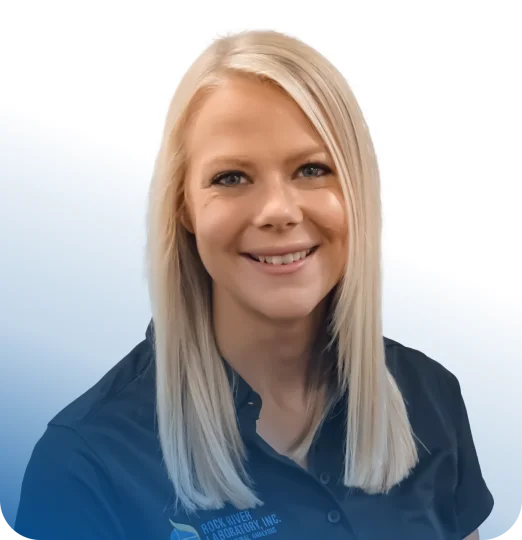
Katie Raver developed a passion for agriculture at a very young age. While attaining her undergraduate degree in animal science at University of Illinois she immersed herself in the dairy industry. After completing her undergraduate degree, she completed a summer internship at Rock River Laboratory and further developed her passion for forage and feed quality. Upon returning to the University of Illinois for her masters degree in Ruminant Nutrition with Dr. Phil Cardoso, she was able to further explore these interests as her graduate work focused on forage quality and fungal disease. She has been at Rock River Laboratory for 5 years and in her current role as animal nutrition technical services director she oversees technical support and development.
Vous avez une suggestion de sujet ?
Envie de devenir notre prochain invité ?
Timestamps & Summary
Chris Gwyn (02:58)
How should nutritionists use lab data to confirm that what’s formulated on paper matches what cows are actually eating and performing?
Katie Raver
A lot of times when we get a feed analysis, we use those feed analysis to formulate our ration.
So we'll pull those into a model and build a ration around those. […]
But I think there's a lot of value beyond that. […]
Even testing things like commodities can help us confirm what we put into that model is what's getting fed to cows. […]
And we can even do this from testing our TMR and making sure what is coming out in the feed mixer and getting fed to cows matches what we have formulated.
Chris Gwyn (04:54)
What are the key recommendations for setting up an effective and practical feed and forage sampling program?
Katie Raver
It's definitely based on a farm-by-farm situation, and so we have to take into account a lot of factors when we set out a sampling recommendation. […]
We have to make sure that we've got someone who's capable of taking those samples, that we trust to take those samples. […]
So some of the key points… is the recommendation of sampling feeds more than we're using 4 or more pounds of. […]
We really weigh it based off of the usage and what the farm can accomplish along with farm size. […]
We've seen success sampling as much as 3 to 5 times a week for our very, very large farms, and as low as 1 every week to every 10 days or 2 weeks.
Chris Gwyn (07:53)
What tools or innovations are helping producers and nutritionists get more value from feed testing data?
Katie Raver
In terms of tools to establish a testing routine would just simply be creating a list of the feeds that we're feeding, usage rates. […]
And we've got some tools built to help producers do that. […]
I think being flexible to dairies is what's enabled us to really capture the most benefit. […]
So some new tools would be being able to trend and track this over time. So if we get a robust enough data set, we can use trend tracking tools and statistics to look at how that feed is changing over time and automatically notify the producer. […]
Chris Gwyn (10:27)
How will artificial intelligence and machine learning impact feed analysis and decision-making?
Katie Raver
One of the challenges… is that for the grand majority of our farms, we don't have a very big dataset. […]
Feed sampling, we maybe do every other week. And so… we have about 25 data points per feed per year. […]
When we look at AI models and machine learning, typically those are able to be utilized when we get hundreds of data points. And so now with a more robust sampling program, we're able to develop this really big dataset that we can leverage these AI tools on. […]
Chris Gwyn (12:28)
What feed hygiene issues are limiting performance, and how should producers think about them?
Katie Raver
I think feed hygiene really is something that we all need to take quite seriously because it can be a production limiter. […]
One of the biggest… misconceptions… is that when we have an issue on a farm, it's one problem. […]
However, most of the time… it's often a combination of these negative things working together that are leading to these issues. So maybe it's not that one thing that we're looking to find, but it's a combination of things. […]
But as we look at the whole picture of what the cow is taking in, that's when we start to see a clearer picture. […]
Chris Gwyn (15:34)
How should feed hygiene testing be used, and what signs should producers watch for on-farm?
Katie Raver
This is a test that's done when we suspect an issue. So we're often a little bit retroactive in our testing for these feed hygiene parameters. […]
However, if we feel like we're not getting the productivity we expect, feed hygiene is definitely something to look at. […]
So, one thing that I tend to recommend people look into would be, are we seeing heating? […]
When we look at our bunk face, is it hot? Do we see evidence of spoilage? Does it smell good or are there some off smells that maybe we need to look into? […]
Chris Gwyn (19:17)
How should fecal analysis be used alongside forage and TMR testing?
Katie Raver
It gives us an insight into what the cow is actually doing with our feed. […]
So things like fecal starch and fecal fat, now we can test through NAR. And so, we have this opportunity to look at what the cow is doing with the starch that we're providing and if there's any opportunity to improve starch digestion. […]
And so it gives us opportunities to look at where we can fine-tune these nutrients and where we can potentially gain more energy from these nutrients. […]
So we can use these tools quite a bit to help benchmark within a herd… to make sure we're making improvements in the right direction. […]
Chris Gwyn (23:07)
What are best practices for sampling and submitting fecal samples?
Katie Raver
If we know that shipping a sample in the heat, we get continual degradation of the starch. So especially in summer months, we want to freeze those samples before we send them. […]
We don't want a pile that's been sitting there for, you know, 2 or 3 hours because again, that starch can be degrading. So when we do it, we want to make sure we're taking the right steps, getting fresh samples, making sure we're getting a representative sample from the pen. […]
So I think always having that baseline is good… we need that baseline to know where we're going and help us make sure we're achieving our goals.
Chris Gwyn (25:35)
What key habits should nutritionists adopt to get more value from lab analysis?
Katie Raver
So what the first one would be: test all your feeds at some routine frequency. […]
Understanding and creating a baseline for the regional area of feeds that you're sourcing, I think is really important. […]
And so just understanding what that is, where you're at, I think will really help fine-tune that ration. […]
And then number two would be looking at trends over time. […]
Tracking those changes over time will give us better insight into how our feed is changing… and that our data is representative of what we're feeding to cows.