- Article
- Poultry
- Pathogens
Breaking the Cycle: Reducing Salmonella Pressure Before Processing
Key takeaways
- Salmonella remains a persistent industry challenge, often carried by without clinical signs.
- High intestinal colonization increases contamination risks during handling and processing.
- Jefo Protected Organic Acids + Essential Oils act synergistically to weaken Salmonella and reduce its survival in the gut.
- Jefo Protected Organic Acids + Essential Oils consistently reduce Salmonella levels across strains and improve downstream outcomes.
A long-standing industry problem
Salmonella has remained a concern for the poultry industry despite advances in management, monitoring, and processing controls. Its persistence continues to drive regulatory attention, product recalls, and added scrutiny throughout the supply chain. One of the main challenges is that birds can carry Salmonella without showing any clinical signs, making it difficult to identify and control before they enter the processing plant.
What Salmonella is and why it matters
Salmonella is a genus of bacteria capable of colonizing the intestinal tract of poultry. Several strains commonly associated with broiler production, including Salmonella Enteritidis, Salmonella Heidelberg, and Salmonella Typhimurium, are also known to cause illness in humans. When the intestinal colonization levels are high, the likelihood of contamination during the handling and processing increases, even in well-managed systems.
How protected organic acids and essential oils act on Salmonella
Organic acids and essential oils work together to target Salmonella in synergistic ways. Essential oils interact with the bacterial cell membrane, weakening its structure and increasing permeability for the entry of other compounds like organic acids. Organic acids, in turn, disrupt normal metabolic functions and make it harder for Salmonella to survive and multiply. When delivered in a protected form, these compounds can reach key sections of the digestive tract in their active form, where Salmonella typically establishes. Together, this combination creates intestinal conditions that reduce Salmonella viability and limit its ability to persist in the intestine.
Why on-farm Salmonella reduction is critical
Once birds reach the processing plant, opportunities to manage Salmonella become more limited. Lowering Salmonella pressure earlier in production helps reduce the overall load entering the plant and supports downstream control measures. In addition, reducing on-farm Salmonella load is key to lowering environmental contamination, helping to reduce the pressure on future flocks. For this reason, strategies that reduce intestinal colonization prior to slaughter play an important role in broader control programs.
Consistent results across Salmonella strains
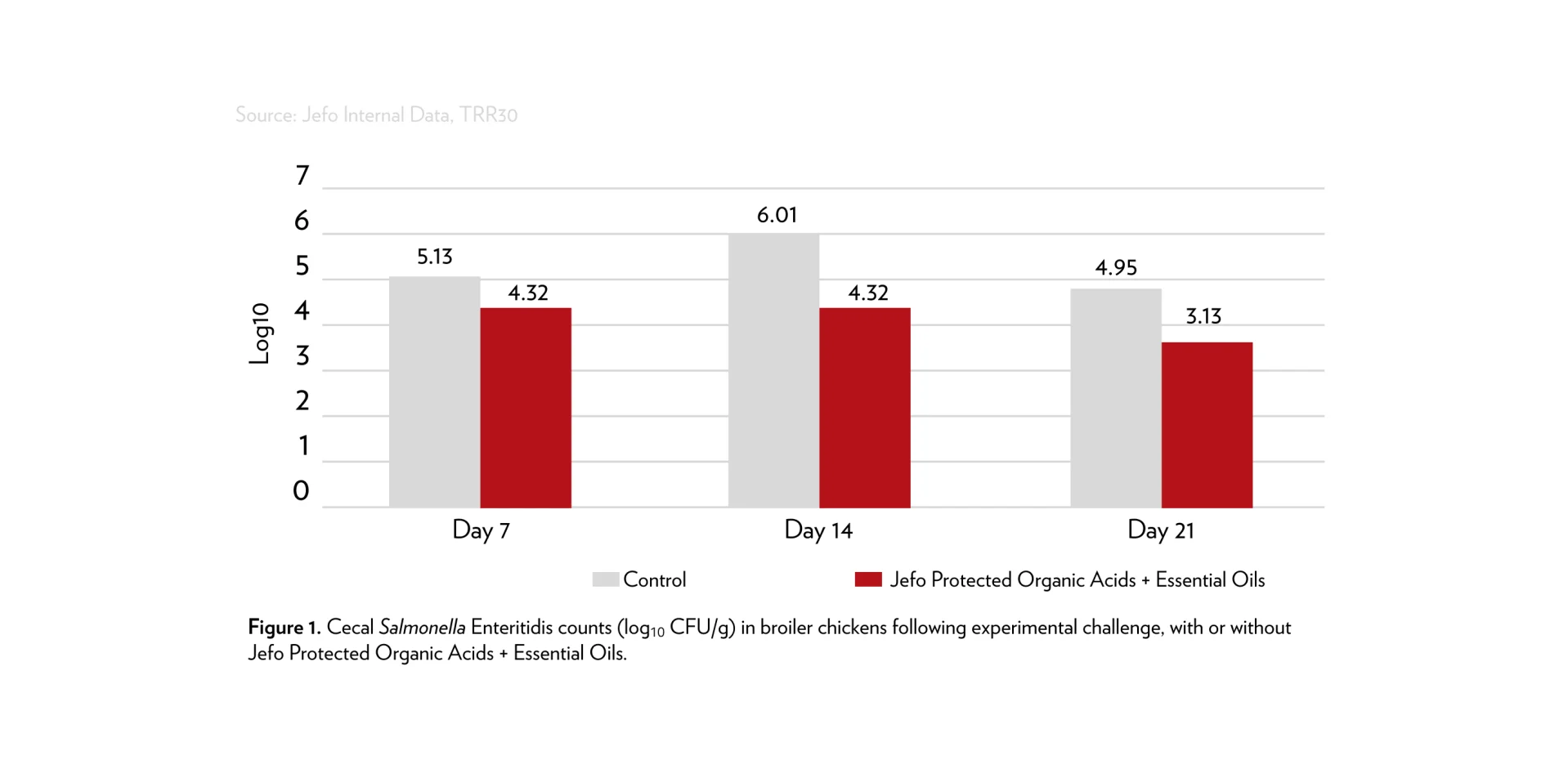
Research has demonstrated consistent reductions in Salmonella counts in broilers supplemented with Jefo Protected Organic Acids + Essential Oils. Controlled challenge studies showed lower cecal counts of Salmonella Enteritidis, Salmonella Heidelberg, and Salmonella Typhimurium compared with non-supplemented controls. This consistency across strains highlights the robustness of the approach.
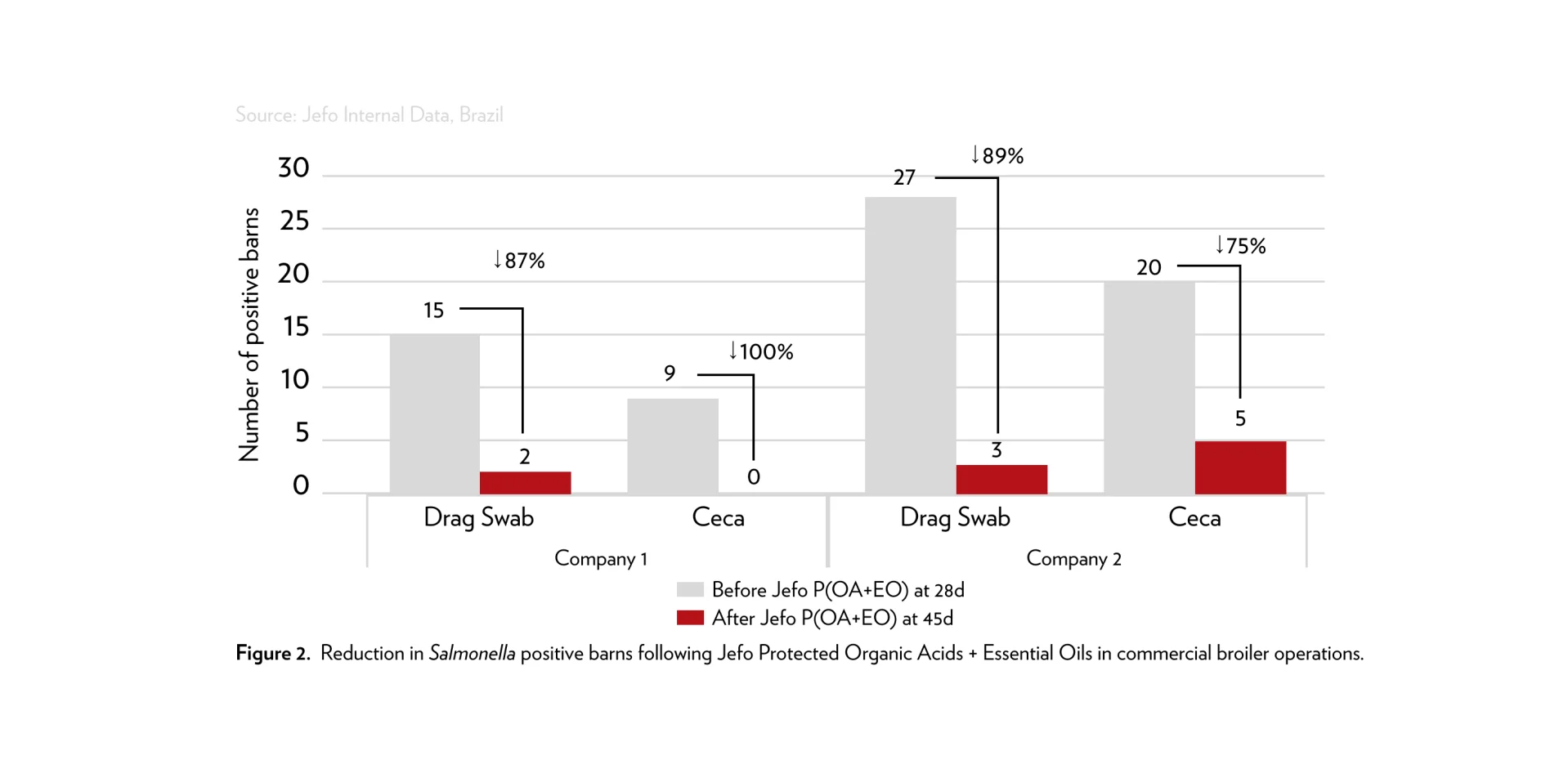
Reduction in Salmonella positive barns near market age
Field data from two commercial broiler integrators show a reduction in the number of Salmonella-positive barns following late-cycle supplementation with Jefo Protected Organic Acids + Essential Oils. Environmental drag swabs and cecal samples collected before supplementation (28 d) and after 7 days of supplementation (45 d) showed fewer positive barns in both companies. These results indicate that short-term supplementation near slaughter is associated with reduced environmental and intestinal Salmonella detection under commercial conditions.
Putting the evidence into context
Taken together, these findings show that Jefo Protected Organic Acids + Essential Oils offer a practical option for managing Salmonella pressure in broiler production. By reducing intestinal colonization before birds reach the processing plant, this nutritional strategy supports broader efforts to limit contamination risk later in the chain. Used alongside existing biosecurity and management practices, it provides producers with an additional tool to address a persistent industry challenge.
Tackling Campylobacter
Explore science-driven approaches to help control Campylobacter in your operation. See how innovative nutritional solutions can support performance and pathogen management.
Our products
See all-
Bestseller
SALOX 100™
Vitamin D3 liquid supplement for the drinking water of poultry and swine -
Bestseller
Multinat EZMIX™
Fermentation products supplement for swine and poultry feeds -
Bestseller

Multinat P-GROW 125™
Fermentation product supplement for poultry feeds -
Bestseller

VIT-AL™
Vitamin supplement to be added to the drinking water for chickens (laying hens and broilers), turkeys and swine -
Bestseller
POULTRYGROW 250™
Enzyme supplement for poultry feeds -
Bestseller
POULTRYGROW 250™
Fermentation product for poultry feeds -
Bestseller

Multinat GROW-PRO™
Fermentation product for poultry and swine -
Bestseller
FORMULA-HP™
Vitamin A, D3 & E premix for poultry and swine -
Bestseller
Enzynat PRO 125™
Enzyme supplement for poultry and swine feeds -
Bestseller
GALLINAT+™
Acidifier and flavouring agent for poultry feeds
Relevant resources
See all-
- Article
- Pathogens
- Gut integrity
High Protease Supplementation: Exploring the Boundaries
Discover how high protease supplementation improves protein digestion, gut health, microbial balance, and resilience in livestock production, including poultry and swine. -
- Article
- Management
- Feed efficiency
- Performance
Precision Brooding Management for Optimal Chick Performance
Early chick management plays a crucial role in long-term flock performance, influencing growth, immunity, and overall health. Discover key factors such as brooding conditions, nutrition, hydration, and environmental management that set the foundation for successful poultry production. -
- Article
- Pathogens
Protein, Protease, and the Pathogen: Rethinking Campylobacter Control
Explore science-driven approaches to help control Campylobacter in your operation. See how innovative nutritional solutions can support performance and pathogen management. -
- Article
- Pathogens
Breaking the Cycle: Reducing Salmonella Pressure Before Processing
Discover why Jefo Protected Organic Acids + Essential Oils is a practical option for managing Salmonella pressure in broiler production—and why it matters! -
- Article
- Sustainability
- Feed efficiency
- Ingredient Stability
- Pathogens
Synchronized Precision Delivery of Nutrients for Gut Harmony and Sustainability
For decades, animal nutrition strategies have focused on boosting productivity by supplementing diets with high-quality ingredients. While this approach has delivered performance gains, it has also exposed a critical vulnerability: the mismatch between digestion and absorption. -
- Article
- Pathogens
- Antibiotics
Fighting Bad Bacteria Naturally with Jefo’s Protected Organic Acids and Essential Oils
Keeping chickens healthy starts in the gut. Just like in people, the gut is home to many “good” and “bad” bacteria. When the balance shifts toward the bad ones, such as E. coli, birds can get sick, grow slower, and use feed less efficiently leading to poor performance. -
- News
- Pathogens
- Ingredient Stability
- Feed efficiency
- Digestibility
Dr. Peter Ferket on the Innovative Lipid Matrix Technology
In the latest episode of The Poultry Podcast Show presented by Wisenetix, Dr. Peter Ferket sits down with Dr. Doug Korver to discuss the potential of lipid matrix technology in poultry production. -
- News
Jefo Nutrition at IPPE 2026
Connect with Jefo experts at Booth A1803 during the International Production and Processing Expo (IPPE), taking place in Atlanta, Georgia, from January 27 to 29, 2026. -
- News
- Pathogens
- Performance
Jean Fontaine on Redefining Animal Nutrition – The Poultry Podcast Show
In the latest episode of The Poultry Podcast Show presented by Wisenetix, Jean Fontaine, founder and president of Jefo, sits down with Dr. Doug Korver to share his perspective on innovation and the future of poultry nutrition. -
- Article
- Management
- Feed efficiency
- Feed cost
- Performance
The Benefits of Managing Protein for Poultry Production
Managing feed protein flow in poultry diets is essential to reduce feed costs. Jefo Protease was developed to enhance this process. It aids in reducing feed costs, allows the use of alternative protein sources, and promotes improved intestinal integrity.