- Article
- Poultry
- Pathogens
Protein, Protease, and the Pathogen: Rethinking Campylobacter Control
Key takeaways
- Campylobacter jejuni is a major poultry-associated foodborne pathogen.
- High cecal Campylobacter jejuni increases processing contamination risk.
- Protein digestion shapes which bacteria thrive in the intestine.
- Better upper-gut digestion and absorption reduce nutrients available to Campylobacter jejuni.
- Jefo Protease improves amino acids digestion and absorption and strengthens intestinal integrity.
- Jefo Protease lowers harmful fermentation and reduces Campylobacter jejuni pressure.
Campylobacter jejuni in broilers
Campylobacter jejuni is frequently found in the poultry digestive tract and usually does not cause visible illness in birds. However, high levels in the cecum increase the likelihood of carcass contamination during processing. Reducing bacterial pressure before birds leave the farm remains an important objective for poultry producers.
Protein digestion shapes the gut environment
Protein digestion influences the gut environment primarily through the efficiency of amino acids and peptides absorption in the upper intestine rather than through the presence of intact proteins reaching the hindgut. Bacteria such as Campylobacter jejuni rely on free amino acids and small peptides, not whole proteins, as nutrient sources. When absorption in the upper intestine is suboptimal, higher concentrations of these substrates remain available further down the tract, supporting bacterial persistence. Improving protease activity upstream increases the release and uptake of free amino acids and small peptides, thereby reducing substrate availability in the lower intestine and helping shape a less favorable environment for pathogenic bacteria like Campylobacter jejuni.
Why better protein digestion can work against Campylobacter jejuni
Campylobacter jejuni has limited ability to break down intact protein on its own. Instead, it depends on small amino acids and peptides that escape absorption earlier in digestion. When protein digestion is improved in the upper intestine, more of these nutrients are absorbed by the bird rather than passing into the lower gut. This leaves fewer resources available where Campylobacter jejuni typically establishes itself.
Jefo Protease increases amino acid transporters and intestinal integrity barrier
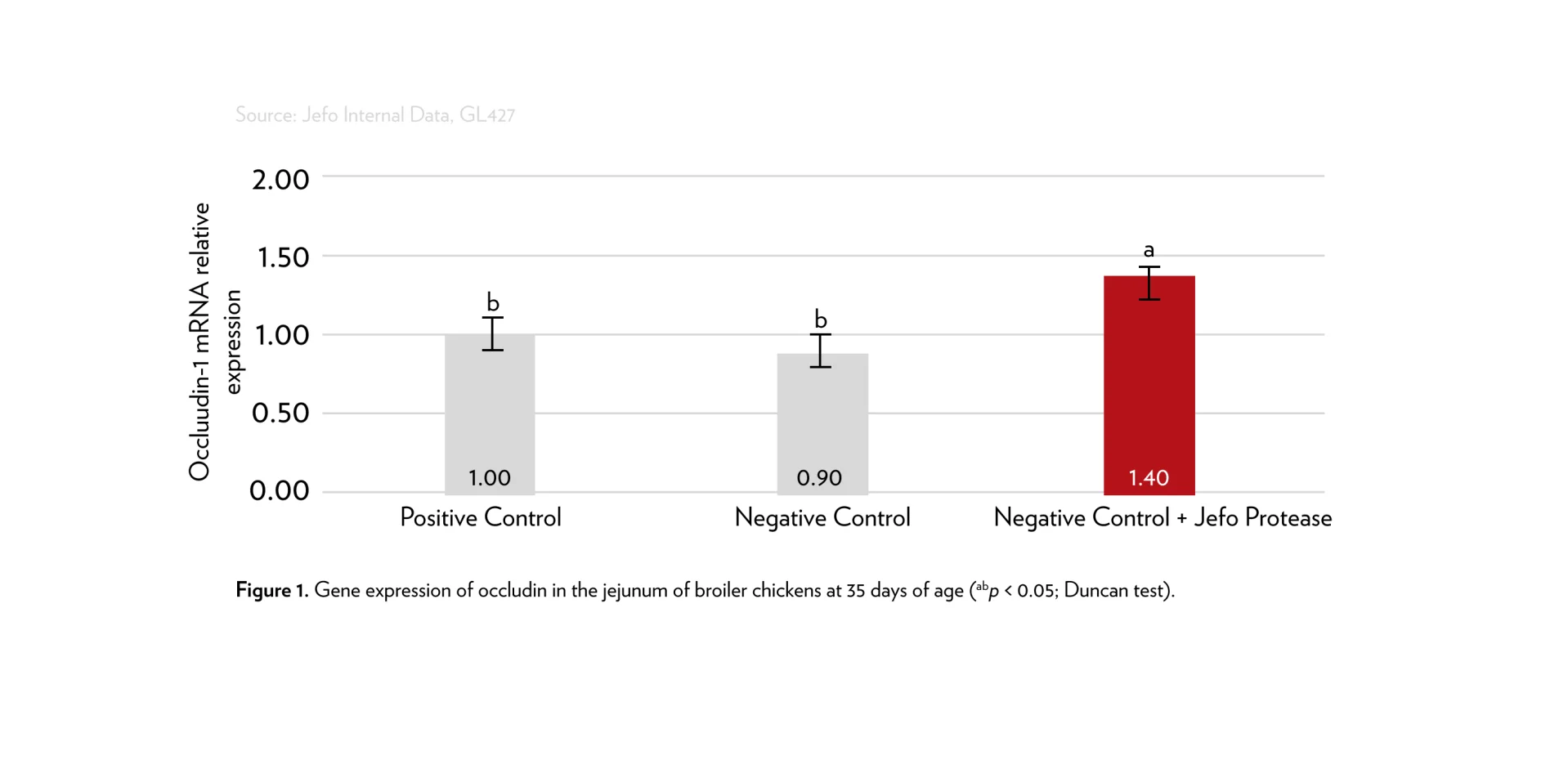
Jefo Protease supplementation improves protein utilization by enhancing the release and absorption of free amino acids and small peptides in the upper intestine. University research has shown increased gene expression of amino acids and peptides transporters in different sections of the small intestine of animals supplemented with Jefo Protease. In broilers at 35 days of age, Jefo Protease supplementation increased jejunal occludin mRNA expression compared with both the positive and negative control groups, as shown in Figure 1. Occludin is a key tight junction protein, and higher expression reflects improved intestinal barrier integrity. Together, enhanced upstream nutrient absorption and a stronger epithelial barrier help limit substrate availability and bacterial translocation further down the intestinal tract, supporting overall gut health.
Reducing undesirable fermentation
When excess protein reaches the lower gut, it is fermented by potentially pathogenic bacteria, producing compounds such as ammonia and biogenic amines. These by-products can disrupt the gut environment and contribute to Campylobacter jejunigrowth. Protease supplementation has been shown to reduce these fermentation products, indicating that more protein is being used efficiently by the bird instead of fueling potentially pathogenic bacteria activity in the hindgut.
Campylobacter control prior to processing
Research conducted by the Montreal University Research Chair in Meat Safety and published in Gut Pathogens (2025) showed that improving protein digestibility through Jefo Protease supplementation can reduce Campylobacter jejuni pressure at key intestinal sites. Broilers receiving the protease-supplemented diet showed lower Campylobacter jejunilevels in the cecum, the primary intestinal reservoir, along with reduced Campylobacter jejuni dissemination to the liver early after colonization. Because high cecal loads and extra-intestinal spread are linked to contamination risk during processing, protein digestibility becomes an important consideration for Campylobacter jejuni control.
What this means in practice
Taken together, these findings highlight the importance of protein digestion as a practical way for managing Campylobacter jejuni pressure in broilers. By helping birds digest and absorb protein earlier, Jefo Protease supplementation limits nutrient availability in the lower gut, supports a better intestinal integrity barrier and reduces conditions that favor bacterial persistence. Used as part of an integrated production strategy, Jefo Protease can serve as a nutritional tool to support healthier birds and better-quality animal protein.
Our products
See all-
Bestseller
SALOX 100™
Vitamin D3 liquid supplement for the drinking water of poultry and swine -
Bestseller
Multinat EZMIX™
Fermentation products supplement for swine and poultry feeds -
Bestseller

Multinat P-GROW 125™
Fermentation product supplement for poultry feeds -
Bestseller

VIT-AL™
Vitamin supplement to be added to the drinking water for chickens (laying hens and broilers), turkeys and swine -
Bestseller
POULTRYGROW 250™
Enzyme supplement for poultry feeds -
Bestseller
POULTRYGROW 250™
Fermentation product for poultry feeds -
Bestseller

Multinat GROW-PRO™
Fermentation product for poultry and swine -
Bestseller
FORMULA-HP™
Vitamin A, D3 & E premix for poultry and swine -
Bestseller
Enzynat PRO 125™
Enzyme supplement for poultry and swine feeds -
Bestseller
GALLINAT+™
Acidifier and flavouring agent for poultry feeds
Relevant resources
See all-
- Article
- Pathogens
- Gut integrity
High Protease Supplementation: Exploring the Boundaries
Discover how high protease supplementation improves protein digestion, gut health, microbial balance, and resilience in livestock production, including poultry and swine. -
- Article
- Management
- Feed efficiency
- Performance
Precision Brooding Management for Optimal Chick Performance
Early chick management plays a crucial role in long-term flock performance, influencing growth, immunity, and overall health. Discover key factors such as brooding conditions, nutrition, hydration, and environmental management that set the foundation for successful poultry production. -
- Article
- Pathogens
Protein, Protease, and the Pathogen: Rethinking Campylobacter Control
Explore science-driven approaches to help control Campylobacter in your operation. See how innovative nutritional solutions can support performance and pathogen management. -
- Article
- Pathogens
Breaking the Cycle: Reducing Salmonella Pressure Before Processing
Discover why Jefo Protected Organic Acids + Essential Oils is a practical option for managing Salmonella pressure in broiler production—and why it matters! -
- Article
- Sustainability
- Feed efficiency
- Ingredient Stability
- Pathogens
Synchronized Precision Delivery of Nutrients for Gut Harmony and Sustainability
For decades, animal nutrition strategies have focused on boosting productivity by supplementing diets with high-quality ingredients. While this approach has delivered performance gains, it has also exposed a critical vulnerability: the mismatch between digestion and absorption. -
- Article
- Pathogens
- Antibiotics
Fighting Bad Bacteria Naturally with Jefo’s Protected Organic Acids and Essential Oils
Keeping chickens healthy starts in the gut. Just like in people, the gut is home to many “good” and “bad” bacteria. When the balance shifts toward the bad ones, such as E. coli, birds can get sick, grow slower, and use feed less efficiently leading to poor performance. -
- News
- Pathogens
- Ingredient Stability
- Feed efficiency
- Digestibility
Dr. Peter Ferket on the Innovative Lipid Matrix Technology
In the latest episode of The Poultry Podcast Show presented by Wisenetix, Dr. Peter Ferket sits down with Dr. Doug Korver to discuss the potential of lipid matrix technology in poultry production. -
- News
Jefo Nutrition at IPPE 2026
Connect with Jefo experts at Booth A1803 during the International Production and Processing Expo (IPPE), taking place in Atlanta, Georgia, from January 27 to 29, 2026. -
- News
- Pathogens
- Performance
Jean Fontaine on Redefining Animal Nutrition – The Poultry Podcast Show
In the latest episode of The Poultry Podcast Show presented by Wisenetix, Jean Fontaine, founder and president of Jefo, sits down with Dr. Doug Korver to share his perspective on innovation and the future of poultry nutrition. -
- Article
- Management
- Feed efficiency
- Feed cost
- Performance
The Benefits of Managing Protein for Poultry Production
Managing feed protein flow in poultry diets is essential to reduce feed costs. Jefo Protease was developed to enhance this process. It aids in reducing feed costs, allows the use of alternative protein sources, and promotes improved intestinal integrity.