- Article
- Poultry
- Management
- Feed efficiency
- Performance
Precision Brooding Management for Optimal Chick Performance
Originally published in Asian Agribiz and authored by Derek Detzler, Senior Technical Services Specialist at Jefo Nutrition.
From pip to pull, processing, holding, and delivery, and then finally placement on farm, the hatchling chick experiences a massive amount of adversity in the first hours post-hatch. From the bird’s perspective, these normal, mostly unavoidable commercial conditions can negatively impact the genetic potential packaged in these 40+ gram prodigies due to the stresses incurred. Usual impairments such as high temperatures and delays without nutrients can impair development. At this same time, physiologically, the cardiovascular, digestive, immune, skeletal, and pulmonary systems must all function at a highly efficient level to support the exponential growth we expect. When you consider it, it’s quite an ask, isn’t it?
Temperature
The first days in the barn are extremely critical for the expected growth and feed efficiency of our birds. Proper brooding conditions are essential for chick survival and early growth. Chicks are homeothermic only after several days post-hatch, making them highly sensitive to environmental temperatures. A study by Yahav et al. (2001) demonstrated that thermal stress during the first week can impair immune function and reduce weight gain. If we can agree on this, then why are many growers failing to take cloacal temperatures at arrival and 4 hours post-placement to assess the actual temperature needs of the chick? Beyond 4 hours, these cloacal measurements should be sampled at a minimum daily for the first 4 days. Standard settings for placement are ill-advised, although all too common. Different settings for brooding temperatures from flock to flock must be understood and applied to achieve above-average starts. Parent age, truck delivery temperatures, bird activity, humidity, etc. all play a role in fine-tuning bird comfort and reducing stress.
Feed
An early window of opportunity appears to exist to help modern genetics achieve their potential through nutritional manipulation in the first hours/days after hatch (Ravindran, 2003). Normally, there is a transition from dependence on the internal residual yolk to an external nutrient supply (traditionally starter feed). The immature gut must rapidly adapt to digesting and utilizing these nutrients in the starter feed, which are relatively complex for the newly hatched bird. Because the intestine is the primary nutrient supply organ, there is a dramatic growth of the gastrointestinal tract and digestive organs in the first week.
Oral nutrient intake is required for gut growth and development. This will not occur with residual yolk or water alone. Early access to feed and water—especially feed—allows the intestines to start developing earlier than if the birds have delayed access to feed (Korver, 2016). Furthermore, the residual yolk contains valuable biomolecules such as maternal antibodies that are better utilized for passive immunity than as a source of energy or amino acids (Dibner, 1999). Ravindran and Abdollahi (2021) stated that the utilization of residual yolk lipids for energy supply is a wasteful process, as specific nutrients in the residual yolk are much more valuable functionally by providing maternal antibodies for passive immunity, as well as phospholipids, choline, and triglycerides for cell membrane development. Such wastage can be mitigated by ensuring access to feed as soon as possible after hatching. With feed intake, gut mucosal structure develops rapidly, with increases in crypt depth, villus height, and villus surface area, which helps reduce intestinal permeability to pathogens.
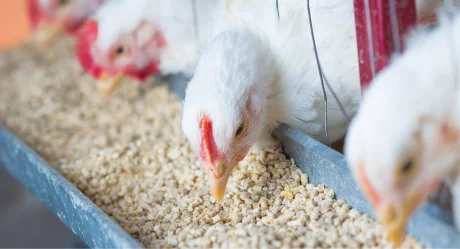
Feed intake during early life appears to be limited by the size of the gastrointestinal tract; therefore, we must recognize the importance of the nutrient value and digestibility of the first feed. Adverse crumble size or poor digestibility can lead to potential inefficiencies in early gastrointestinal growth. This could limit maximum phenotypic expression in modern broiler chickens with superior growth potential (Ravindran, 2003).
Some of the early mortality and morbidity attributed to dehydration and starvation may actually be due to the failure of chicks to consume feed immediately after placement (Xin and Lee, 1997). Based on their work in Leghorn chickens, they concluded that undernutrition plays a more important role than dehydration in causing morbidity post-hatch. Noy and Sklan (1999) reported that feeding a solid, semi-solid or liquid nutrient post-hatch increased body weights that were maintained to market in chicks and poults. Ingestion of water immediately post-hatch enhanced body weights, but no significant advantage was observed after 8 days.
Nutrition
Poultry nutritionists do their best to formulate and deliver the specific nutritional requirements of the newly-hatched chick or poult based on the raw ingredients that are locally or readily available. We can conclude that not all of these ingredients are highly digestible, specifically in the first hours or days post-hatch, when the gastrointestinal system of the bird is underdeveloped and not able to efficiently utilize all of the nutrients. Kim et al. (2021) reported that up to 30% of the feed nutrients provided to birds were undigested. We must scrutinize the indigestible portion of feed in those critical first hours, as it can lead to suboptimal microflora development. This issue can be exacerbated in situations where antimicrobials have been removed or reduced in use.
Practical steps to ensure optimal development
Minimizing the time to first feed and providing specific, highly digestible nutrients as soon as possible is advantageous. Many have tried formulating special pre-starters to achieve this; however, the commercial realities of extra deliveries to the farm are limiting. Many new concepts of in-hatchery feeding or on-farm hatch are being used, but they are not an option for most producers.
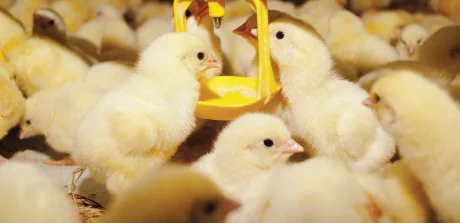
Supplemental feed at placement is recommended by most health or nutrition professionals. Routinely, this extra feed is included in feeds trays or placed on paper strategically within the brood area. Farmers go to great lengths to ensure feed crumbles are readily available for the bird to consume immediately at placement. However, we should consider alternative strategies to enhance and encourage more curiosity and faster uptake of highly digestible nutrients that will also stimulate gizzard activity. Ravindran (2021) commented that the gizzard is known as the ‘pace-maker’ of normal gut motility. In addition to contributing to the grinding action, increased activity of the gizzard allows greater gastric and/or intestinal refluxes (Sing 2014), thus improving mixing of digesta with enzymes and nutrient digestion. Having a product that is highly digestible and promotes and gizzard stimulation is only part of the puzzle that needs to be pieced together.
Water
Water is often overlooked but is vital for digestion, thermoregulation, and metabolic function. Chicks can lose up to 10% of their body weight in the first 24 hours if water is not readily available. Water should be tested regularly to ensure cleanliness and the absence of harmful pathogens. The birds’ immune system is not fully functional at placement; therefore, any water-quality-related challenges can be more detrimental at an early age. Ease and availability of water at placement are a must. According to May et al. (1997), water deprivation during the first 48 hours significantly reduces growth and increases mortality. Most producers would argue that their birds are all drinking at 48 hours—but can they prove this? Are there measurements that we can quantify? Most conventional water meters are unreliable at this age due to low volumes. Assessing the malleability of the feed in the crop during routine crop-fill checks can provide a clue to the ingestion —or absence—of water.
The general principles of brooding management haven’t changed significantly over the years. Over the last few decades, the constant improvement in genetics has advanced our production in many ways. To realize this benefit in full, brooding management is a critical stage that must continually evolve. Flock-to-flock considerations or changes should be commonplace. Benchmarking weight, crop fill, water consumption, and cloacal temperatures, as well as the use of adapted water-quality programs and specific feed additives (e.g. enzymes, microencapsulated functional ingredients such as organic acids and essential oils) in those first few days, are great foundational tools to start the journey to maximizing the full potential of your bird.
Our products
See all-
Bestseller

SALOX 100™
Vitamin D3 liquid supplement for the drinking water of poultry and swine -
Bestseller
Multinat EZMIX™
Fermentation products supplement for swine and poultry feeds -
Bestseller
Multinat P-GROW 125™
Fermentation product supplement for poultry feeds -
Bestseller
VIT-AL™
Vitamin supplement to be added to the drinking water for chickens (laying hens and broilers), turkeys and swine -
Bestseller
POULTRYGROW 250™
Enzyme supplement for poultry feeds -
Bestseller
POULTRYGROW 250™
Fermentation product for poultry feeds -
Bestseller
Multinat GROW-PRO™
Fermentation product for poultry and swine -
Bestseller
FORMULA-HP™
Vitamin A, D3 & E premix for poultry and swine -
Bestseller
Enzynat PRO 125™
Enzyme supplement for poultry and swine feeds -
Bestseller
GALLINAT+™
Acidifier and flavouring agent for poultry feeds
Relevant resources
See all-
- Article
- Pathogens
- Gut integrity
High Protease Supplementation: Exploring the Boundaries
Discover how high protease supplementation improves protein digestion, gut health, microbial balance, and resilience in livestock production, including poultry and swine. -
- Article
- Management
- Feed efficiency
- Performance
Precision Brooding Management for Optimal Chick Performance
Early chick management plays a crucial role in long-term flock performance, influencing growth, immunity, and overall health. Discover key factors such as brooding conditions, nutrition, hydration, and environmental management that set the foundation for successful poultry production. -
- Article
- Pathogens
Protein, Protease, and the Pathogen: Rethinking Campylobacter Control
Explore science-driven approaches to help control Campylobacter in your operation. See how innovative nutritional solutions can support performance and pathogen management. -
- Article
- Pathogens
Breaking the Cycle: Reducing Salmonella Pressure Before Processing
Discover why Jefo Protected Organic Acids + Essential Oils is a practical option for managing Salmonella pressure in broiler production—and why it matters! -
- Article
- Sustainability
- Feed efficiency
- Ingredient Stability
- Pathogens
Synchronized Precision Delivery of Nutrients for Gut Harmony and Sustainability
For decades, animal nutrition strategies have focused on boosting productivity by supplementing diets with high-quality ingredients. While this approach has delivered performance gains, it has also exposed a critical vulnerability: the mismatch between digestion and absorption. -
- Article
- Pathogens
- Antibiotics
Fighting Bad Bacteria Naturally with Jefo’s Protected Organic Acids and Essential Oils
Keeping chickens healthy starts in the gut. Just like in people, the gut is home to many “good” and “bad” bacteria. When the balance shifts toward the bad ones, such as E. coli, birds can get sick, grow slower, and use feed less efficiently leading to poor performance. -
- News
- Pathogens
- Ingredient Stability
- Feed efficiency
- Digestibility
Dr. Peter Ferket on the Innovative Lipid Matrix Technology
In the latest episode of The Poultry Podcast Show presented by Wisenetix, Dr. Peter Ferket sits down with Dr. Doug Korver to discuss the potential of lipid matrix technology in poultry production. -
- News
Jefo Nutrition at IPPE 2026
Connect with Jefo experts at Booth A1803 during the International Production and Processing Expo (IPPE), taking place in Atlanta, Georgia, from January 27 to 29, 2026. -
- News
- Pathogens
- Performance
Jean Fontaine on Redefining Animal Nutrition – The Poultry Podcast Show
In the latest episode of The Poultry Podcast Show presented by Wisenetix, Jean Fontaine, founder and president of Jefo, sits down with Dr. Doug Korver to share his perspective on innovation and the future of poultry nutrition. -
- Article
- Management
- Feed efficiency
- Feed cost
- Performance
The Benefits of Managing Protein for Poultry Production
Managing feed protein flow in poultry diets is essential to reduce feed costs. Jefo Protease was developed to enhance this process. It aids in reducing feed costs, allows the use of alternative protein sources, and promotes improved intestinal integrity.